top of page
Modern Suburban Home

 Types of Home Insurance Coverages 

*Source TDI

Home policies combine several types of coverage into one policy. Most home policies in Texas include these six coverages:


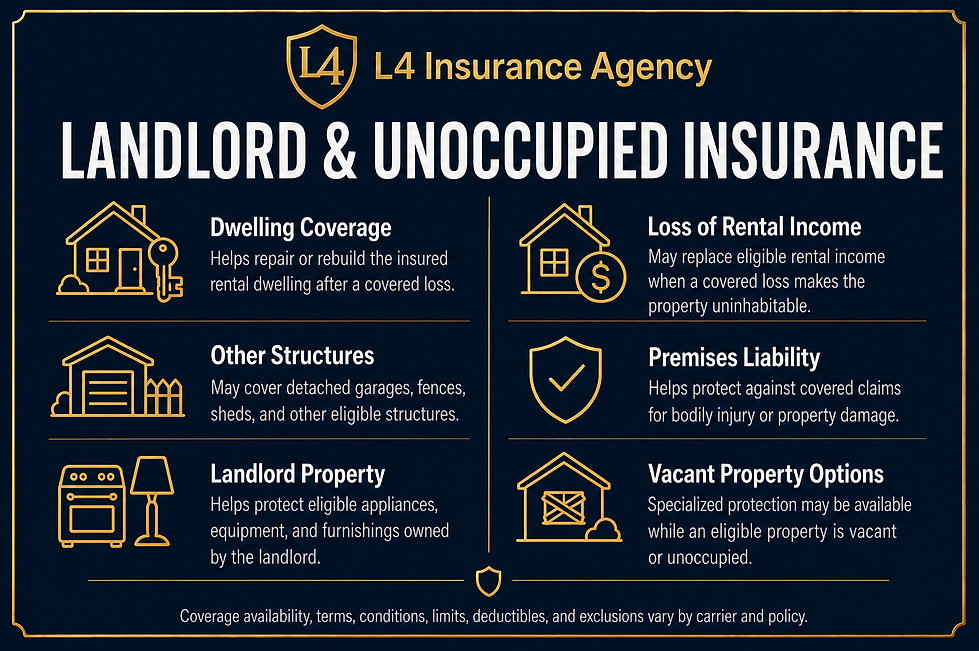
1. Dwelling coverage pays if your house is damaged or destroyed by something your policy covers.


2. Personal property coverage pays if your furniture, clothing, and other things you own are stolen, damaged, or destroyed.


3. Other structures coverage pays to repair structures on your property that aren’t attached to your house. This includes detached garages, storage sheds, and fences.


4. Additional living expenses coverage pays if you have to move while your house is being repaired to fix damages your policy covers. Additional living expenses include rent, food, and other costs you wouldn’t have if you were still in your home.


5. Personal liability coverage pays medical bills, lost wages, and other costs for people that you’re legally responsible for injuring. It also pays if you’re responsible for damaging someone else’s property. It also pays your court costs if you’re sued because of an accident.


6. Medical payments coverage pays the medical bills of people hurt on your property. It also pays for some injuries that happen away from your home – if your dog bites someone at the park, for instance.

What risks does a home policy cover?

Your home policy protects you against different risks, or perils. Risks and perils are things that could damage your house or property. This table shows common risks that most policies do and don’t cover. Coverages vary by company. Read your policy or talk to your agent to be sure of your exact coverages.

Most policies cover damages from:

Fire and lightning

Sudden and accidental release of water or smoke


Explosion

Theft

Vandalism, malicious mischief, riot, and civil commotion

Windstorm, hurricane, and hail (but not if you live on the Gulf Coast)

Most policies cover damages from:

Flooding

A continuous water leak; policies also won’t cover mold removal, except to repair damage caused by a covered risk

Termites, insects, rats, or mice

Losses that occur if your house is vacant for the number of days specified by your policy

Wear and tear

Wind or hail to trees and shrub

Modern Home Entrance

Replacement cost vs. actual cash value coverage

Home policies provide either replacement cost coverage or actual cash value coverage. To be fully protected, make sure your policy has replacement cost coverage.

  • Replacement cost coverage pays to repair or replace your house and personal property at current prices. For example, say you bought a new roof 10 years ago and the current price for a new roof is $10,000. If you have to replace your entire roof after a storm, a replacement cost policy would pay for a new roof at today’s prices. If you have a $2,000 deductible, your company would pay $8,000.


  • Actual cash value coverage pays replacement cost minus depreciation. Depreciation is a decrease in value because of wear and age. In the same example of the 10-year-old roof, the actual cash value might be $7,000. After your $2,000 deductible, your company would pay $5,000. You’d have to pay the rest of the cost of the new roof yourself. This means your total out-of-pocket costs for an actual cash value policy would be $5,000, compared with $2,000 for a replacement cost policy.

Fallen Tree Damage


Deductibles and dollar limits

If you have a claim, you must meet a deductible.


A deductible is the amount of a claim that you must pay yourself. For instance, if you have a $1,000 claim and your policy has a $300 deductible, the insurance company will deduct $300 from your claim amount and pay you $700. You might have different deductibles for each type of coverage.


Learn more: What to know about deductibles


Policies pay only up to their dollar limits.


Each type of coverage has a dollar limit. Make sure you have enough coverage to replace your home and property if you have a total loss. If you don’t have enough coverage, you’ll have to pay the difference yourself. Most companies require you to insure your house for at least 80% of its replacement cost. Some companies require you to insure your house for 100% of its replacement cost.


The first page of your policy is the declarations page.  It has a summary of your policy, including your coverages, dollar limits, and deductibles.


Personal property coverage


Home policies usually pay a percentage of your dwelling coverage limit to repair or replace your furniture, clothes, and other property. For example, say you insure your house for $100,000 and your policy covers your property at 20% of that. Your personal property would be insured for up to $20,000.


Home policies limit what they’ll pay for things like jewelry and art. If you own expensive jewelry, art, or other items, talk to your agent about adding more coverage.


Make a list of the items you own.


A complete list of your property will help you decide how much coverage you need and will make filing claims easier.


Update your list regularly. If you can, include the date you bought each item, its value, and its serial number. This is especially important for expensive items. Photograph or videotape each room, including closets, storage buildings, and your garage. Open drawers and photograph what’s inside. Keep the list and receipts for major items in a fireproof safe or at another location. Use our Home Inventory Checklist to help make your list.


Learn more: You need a home inventory


Other coverages you might need


Your home policy might not protect you against some risks. You can buy a separate policy or add on to your policy if you need more protection.


Flood insurance


Most home policies don’t cover damage caused by floods. If your home is in a designated flood zone, your lender requires you to have flood insurance. But floods can happen anywhere. More than half of homes flooded by Hurricane Harvey were outside of designated flood zones.


Talk to your home insurance agent about getting a flood policy from your insurance company or the National Flood Insurance Program. If your agent doesn’t sell flood insurance, call 877-336-2627 for help. Most flood policies have a 30-day waiting period before kicking in so don’t wait for an approaching storm before deciding to buy coverage.


Learn more: Do you need flood insurance?


Windstorm and hail insurance on the Gulf Coast


If you live on the Texas coast or in Harris County on Galveston Bay, your home policy doesn’t cover wind and hail damage. The Texas Windstorm Insurance Association (TWIA) sells wind and hail coverage for coastal residents. You buy TWIA coverage from local insurance agents. Depending on where you live, you might need flood insurance before TWIA will sell you a policy. You also might need a home inspection by an engineer or a windstorm inspector. For more information, visit twia.org or call 800-788-8247.


Don’t wait until the last minute to buy wind and hail insurance. TWIA won’t sell you a policy if there’s a hurricane in the Gulf of Mexico.


Learn more: Home, flood, wind:


Which policies do you need? 

What is windstorm insurance?

Watch: Windstorm insurance inspections


Extra liability coverage


Home policies provide liability protection, but the amount of coverage is limited. If you want more coverage than your policy provides, you can buy a separate umbrella liability policy.


Extra coverage (endorsements)


Most companies offer endorsements, or policy add-ons, that let you increase or add coverage. Common endorsements include coverage for:


  • Jewelry, fine arts, or electronics (your policy provides some coverage, but it might not be enough to cover expensive items).

  • Backup of sewers or drains.

  • Damage to foundations or slabs.

  • Extra construction or repair costs to meet local building codes.

  • Extra construction costs if your policy doesn’t pay enough to rebuild your home.

  • Mold removal.

  • Damage from earthquakes.

Coverage for short-term rentals


Most policies won’t pay for damages or injuries that occur during short-term rentals. If you rent out your house for short-term lodging, ask your insurance agent if you’re covered. You might need to buy more coverage.


If you’re a guest in a short-term rental, your home or renters policy might cover you if you damage a host’s property. Ask your insurance agent before you rent. If you’re renting through an app or website that offers insurance coverage, ask your agent if you need it.


Learn more: Home sharing: 3 questions to ask


Other types of property insurance


Renters insurance covers your clothes, furniture, and other personal property if they’re stolen or damaged while you’re living in a rented house or apartment. Renters insurance won’t pay to fix the house or apartment building. The building owner’s policy does that. You might not need renters insurance if you’re still a dependent. Your parents’ home policy might cover your property, even if you’re not living at home.


Condominium insurance covers your personal property and the interior of your unit. It also provides liability protection and pays additional living expenses.


Townhouse insurance can either cover the interior and exterior of your townhouse, or just the interior. The difference depends on whether the homeowners association has a master policy that covers the exterior. If it does, you can buy a policy that covers only the interior. If the association’s master policy doesn’t cover the exterior, you can buy a policy that covers both the interior and exterior. Townhouse insurance also covers your personal property and provides liability and additional living expenses coverage.


Mobile home insurance covers the mobile home, your personal property, and additional living expenses. It also provides liability coverage.


Farm and ranch insurance is for homes outside city limits on land used for farming and raising livestock.

Principal Agent #1344741

L4 Consultants, L.L.C. dba L4 Insurance Agency 
Agency License #: 21765749
General Lines License #: 3412847
NPN #: 8574999

BIO


Israel Ledesma is the Principal Agent of L4 Insurance Agency and founder of L4 Advisory, bringing over 30 years of experience across financial services, real estate, insurance, and risk management. With a background in banking, business controls, and operational strategy, he approaches insurance as a critical component of comprehensive risk management.

Israel holds an Executive MBA from the University of Texas at San Antonio and maintains active licenses in both real estate and insurance. He is committed to delivering disciplined, advisory-driven solutions that help individuals, families, and businesses protect assets, manage risk, and achieve long-term financial stability.

Office: 210-380-0551

L4 Advisory is a strategic consulting platform focused on risk management, financial insight, and operational discipline across real estate, insurance, and business environments. We help individuals and organizations make informed decisions, align resources, and build long-term value through structured, advisory-driven solutions.

© 2035 by I. Ledesma. Powered and secured by Wix

bottom of page